
By Heather Munnell, Senior Director of Client Experience & Strategy, VDA, Inc.
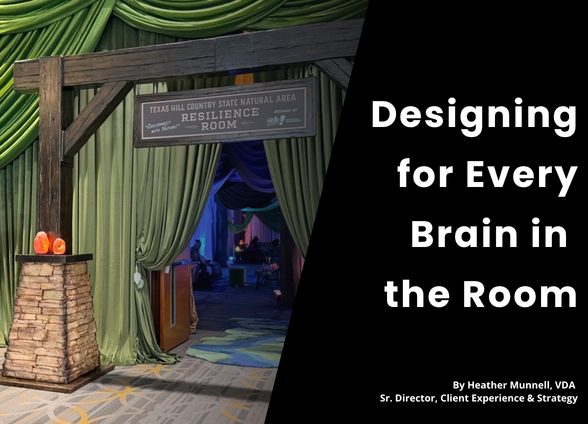
I was at MPI WEC recently — surrounded by thousands of the most passionate event professionals in the world, doing exactly what we all came to do — and somewhere between the general sessions and the networking and the beautiful, relentless energy of it all, I slipped into the Resilience Room.
Someone had pulled me aside earlier that day and told me I had to check it out. So I went in curious — and what I found genuinely stopped me. The scent, the sounds, the way the whole space was designed to speak to every sense at once and somehow bring everything down instead of up. I sat down, I took a breath, and for a few minutes I just let myself be in it.
What It Means to Be an Ambivert at an Event
I’ve been in this industry long enough to know I love it. I love the rooms, the energy, the way the right environment can shift how people think and feel and connect. And I also know that after two days of it, I hit a wall. I always have. For a long time I thought that was just me — something to manage quietly and push through. Then I came across the word ambivert, and something clicked.
An ambivert is someone who lives in the space between introvert and extrovert. Social and energized by connection, but also genuinely depleted by it. Someone who can work a room and then needs to disappear for twenty minutes before they can do it again. When I read that definition I thought — that’s most people, actually. We just don’t design events that way. We design for the assumption that more is always better, that louder means more engaging, that a packed schedule signals value. And we quietly expect everyone in the room to keep up.
The Resilience Room stopped me in my tracks because it was proof that someone at the highest level of our industry understood something we don’t talk about enough: people experience events very differently, and the environment we build either supports that or it doesn’t.
Why This Is Personal to Me
I have a son who is on the autism spectrum. Watching him move through the world has quietly reshaped how I see everything, including my own work. He wears headphones. He needs to know what’s coming next. Things I find electric — surprise activations, sensory-rich environments, the kind of crowd energy that makes an experiential designer’s heart race — he finds genuinely hard to be in. His brain is wired differently, and most of the spaces we design weren’t built with that wiring in mind.
When I found that room at WEC I thought about him. And I thought about everyone at that conference who had quietly been managing — masking, white-knuckling through overstimulation, slipping out of sessions not because they weren’t engaged but because the environment crossed a threshold they couldn’t explain to anyone around them. Those people are our attendees, our clients, our speakers. They show up, they contribute, they do the work — and they do it carrying something most event designs don’t make room for.
How the Events Industry Is Starting to Shift
What gives me real hope is that the industry is starting to shift. WEC had the Resilience Room. PCMA went further and handed out sensory kits on-site, actual tools for attendees to use in real time. Those are design decisions, made intentionally, by people who understood the room holds more than one kind of brain.
That’s the standard I think we should be holding ourselves to, thought about the same way we think about flow, lighting, sound, and moment. What does the person who needs quiet have access to? What does the person who processes differently get to participate in?
What Neuro-Inclusive Event Design Actually Looks Like
The answers aren’t complicated. Quiet decompression spaces. Predictable transitions and clear wayfinding. Flexible formats that don’t require everyone to engage the same way. Networking that isn’t only a loud cocktail hour. Sensory environments built with range in mind, not just intensity.
We are experiential designers. We shape how people feel inside a space. There is no more direct application of that skill than designing for the full spectrum of how people actually experience the world.
Every brain in that room is a potential client, a collaborator, an advocate. That room stuck with me more than anything else at WEC, and I think it’s one we should all be paying attention to.