
VDA’s Experience at CEMA Summit 2026
CEMA Summit didn’t end with a keynote. It ended with a room full of people still trying to finish a conversation they’d only just started.
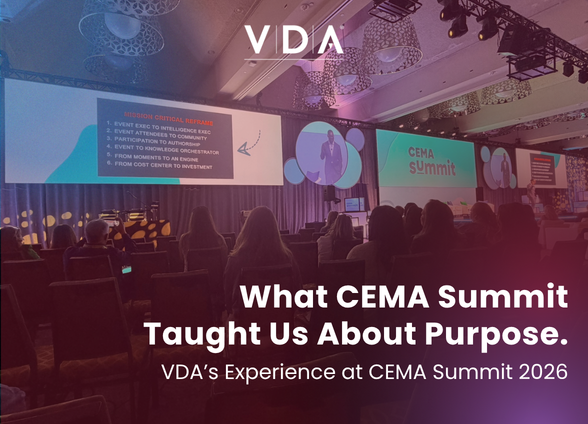
Alyce DelGrosso, David G. Breen, and Heather Munnell represented VDA in Toronto, where the closing main stage session, “B2H: Business-to-Human Marketing,” with Omar Johnson, provided one of the most compelling perspectives of the two-day summit. Johnson has built his career around this philosophy. He was part of the team behind Beats by Dre, turning a pair of headphones into a cultural symbol before it was ever just a product. He brought that same philosophy to the Beats’ activation for athletes inside the Olympic Village, which didn’t just serve the athletes and guests in the room, but generated buzz that traveled far past the Village gates and kept the brand in the conversation long after the Games moved on. Johnson’s message was simple, but its implications were bigger: stop thinking about what you produce, and start thinking about what you build. The event executive becomes an intelligence executive. The attendee becomes part of a community. A single moment becomes an engine that generates value long after the room empties.
That idea landed right before the closing networking activities and party, and people walked straight out of the session still holding it, still wanting to talk it through. That’s exactly what happened, in pockets, in half-finished sentences, in the kind of energy you only get when a room is genuinely fired up. But a party is built for quick hellos and good music, not for sitting with an idea long enough to let it change how you think. The summit ended on its most dynamic note, and then ran out of room to let it land.
Business back home has a way of pulling at you no matter where you are, but the team stayed in it, the keynotes, the late nights, the networking, all of it. Not just the keynotes or sessions, but the conversations between them. What came home with us was shaped as much by the people we met as by what we heard from the stage. Most of what came home with us didn’t happen in the sessions themselves, it happened in the room, between people. The themes below only surfaced because someone stayed to hear them.
“Community” kept surfacing as the real deliverable. Not another lanyard scan, but the sense of finding people who get it. Sessions like “Designing Moments That Move People” and “The Space Between” made the same case: the moments that stick aren’t the biggest, they’re the ones that feel personal. If human connection is this valuable, the honest question is what we’re actually measuring, return on investment, or return on emotion, the social mentions and the connections and meetings that happen because someone actually wanted them to.
That question carried into one of the sharpest sessions of the trip, on the agency-client relationship itself. The biggest blind spot brands have with their partners is jumping straight to tactics without sharing the strategic picture behind the ask. The clients people remember lead with empathy, treat vendors like people, and are honest early when something isn’t working. The fastest way to kill agency efficiency is the opposite: over-prescribing every detail or being dishonest about budget from the start.
None of that matters if the experience itself isn’t worth showing up for. “Your Attendees Don’t Want Content, They Want Access” was a reminder that differentiation isn’t optional. Don’t build what everyone else is already building. An experience has to earn its place in a crowded field competing for the same attention.
AI entered the conversation differently than usual, too. “Do More of the Work You Enjoy: Leveraging AI to Amplify Event Teams” made the case that the technology’s real value isn’t in what it can generate, it’s in what it clears out of the way. Less time buried in logistics and spreadsheets means more time for the parts of the job a machine was never going to do well anyway. The room kept circling back to that list: reading a room, holding a genuine conversation, noticing when someone needs a different kind of moment. The framing wasn’t fear of being replaced, it was clarity about what was never replaceable in the first place.
That same instinct showed up on the show floor, not just on stage. A couple of on-site activations, a color-matching experience, painting with wine, made the point better than any panel could. Nothing elaborate about either one, just clever enough to give a stranger a reason to strike up a conversation with the person next to them. Scale and spectacle weren’t what made either memorable. Specificity was, the same idea Johnson opened the summit with, just proven in miniature.
The industry keeps changing shape, new platforms, formats, tools every year. What doesn’t change is why Alyce, David, and Heather carved three days out of a business that doesn’t pause to be in a room with people who do this work too. Not for the sessions alone, but for the same thing Johnson was arguing for from the stage, people showing up for other people, building something worth staying for. That’s why CEMA is worth it, and why we’ll be back.