
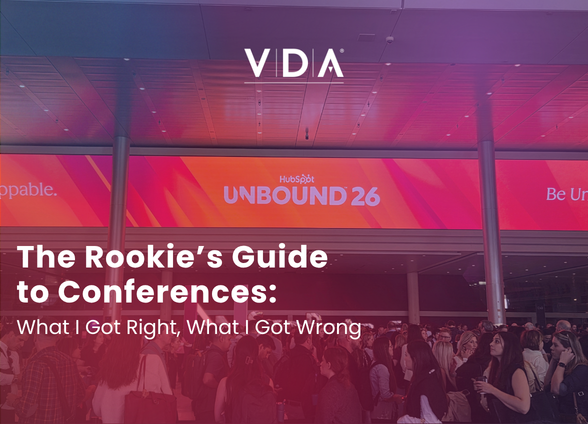
The Rookie’s Guide to Conferences: What I Got Right, What I Got Wrong
What my first major conference taught me about preparation, pacing, networking, and getting the most out of a very long day.
I work in marketing for an experiential events agency, so conferences and conventions aren’t exactly unfamiliar territory. My office is filled with creative minds designing, building, managing and producing large-scale environments, exhibits, stages, and experiences that bring brands to life at events around the country. While my role is different; focusing on marketing I am telling the story of what we create, watching the videos, and promoting the content. After a year in the industry, UNBOUND 2026 was my first chance to actually attend a convention myself.
I thought I knew what to expect.
Then I saw the registration line.
I was impressed by the energy, the scale, the sessions, and the sheer amount happening around me. I also made a handful of rookie mistakes that, in hindsight, were completely avoidable.
Rookie Mistake #1: Not Doing Enough Ahead of Time
My first lesson came before I even made it into my first session.
I arrived at the convention center on Wednesday morning about an hour before the first session I wanted to attend. That felt like plenty of time. It was not. I should have known I was missing that 10am session when I was straining to see over the crowd and saw UNBOUND staff handing out free cold drinks to those in the back of the lines… not a good omen.
As a first-time conference attendee, it was a rough introduction. But as someone who works in experiential marketing, it also gave me a perspective I hadn’t had before: experiencing an event entirely from the attendee side. At VDA, we focus on creating experiences for our clients and their brands, but ultimately, that means creating a positive experience for the people attending. Every touchpoint matters, especially the very first one. You could tell the UNBOUND team was aware of the tension. Staff were circulating with complimentary drinks, music was turned on in the lobby, and there were clear attempts to make the wait feel less frustrating. From my perspective, much of that chaos probably could have been avoided with a smoother registration process and better crowd management. At the same time, it was an important reminder that no event goes perfectly.
By the time I finally had my badge in hand, my first session had already been underway for about 30 minutes. Missing that first session was a little discouraging, but it was a glaring lesson learned early on: I hadn’t taken advantage of the things I could have done before event day.
UNBOUND offered badge pickup the day before the event, and the worst part about it, I was local.
Session registration also opened two weeks before the event. Registering ahead of time ended up being one of the things I did right. It gave me a plan and helped me think intentionally about what I wanted to get out of the conference instead of trying to figure it out while walking around the show floor.
The lesson was simple: do everything early that you can.
Pick up your badge. Register for sessions. Look at the schedule. Figure out where you need to be. Give yourself a chance to arrive knowing what you’re doing instead of trying to solve everything once you’re already surrounded by thousands of other attendees.
Rookie Mistake #2: Thinking I Could Just Power Through
This might have been my biggest surprise: conferences are exhausting. And I mean that in every possible way.
Conferences are physically demanding, even when you aren’t doing anything that feels particularly strenuous. You’re on your feet, walking between sessions, navigating crowds, standing in lines, and constantly moving from one thing to the next.
Then there’s the mental side.
You’re listening to sessions, taking notes, meeting people, absorbing new information, trying not to miss anything interesting happening around you, and everywhere you look a brand is fighting for your attention. It’s incredibly overstimulating and you’re doing it for eight, nine, sometimes 11 hours.
Because I’m an active person, I assumed I’d be fine. I went home each night and stuck to my normal routine. I went to the gym, stayed up later than I probably should have, and figured I’d catch up on sleep eventually.
By the middle of the second day, I was starting to crash.
By Friday, I arrived about an hour later than I had originally planned, fueled primarily by guilt over the price of my ticket and three espresso shots.
It turns out comfortable shoes aren’t the only thing you need for a conference. If you’re attending a multi-day event, don’t underestimate the mental and physical toll of being “on” for that long. Give yourself permission to slow down before and after the event. You don’t have to maintain your normal schedule just because you’re technically capable of doing so.
Rookie Mistake #3: Trying to Fit Everything In
I went into UNBOUND wanting to make the absolute most of my time. So naturally, I tried to fit everything into my schedule. This is where I learned that having access to dozens of interesting sessions doesn’t mean you need to attend all of them.
One of the best decisions I made was intentionally blocking off an hour and 15 minutes for lunch. UNBOUND had a great selection of food trucks, but I waited about 45 minutes to actually get my food. If I had only given myself 30 minutes for lunch, I would have spent the entire break worrying about missing my next session. It can be tempting to skip lunch because there’s another speaker you really want to see. But eventually, your body is going to remind you that food is not optional.
Build downtime into your schedule. You don’t need to maximize every minute to maximize your experience. Fueling yourself and giving your brain a chance to process what you’re learning will ultimately help you get more out of the rest of the day.
Rookie Mistake #4: Arriving Way Too Early
There’s being prepared, and then there’s whatever I was doing on day one.
For some reason, I treated conference sessions like TSA. I was arriving 20, maybe 25, minutes before sessions that absolutely did not require it.
Eventually, I realized that most attendees were arriving about five to 10 minutes before a session, particularly for the larger stages. If I had a reserved seat, 10 minutes was generally more than enough time. For larger open sessions, arriving around the same time gave me plenty of options.
Those extra 20 minutes could have been spent exploring the show floor, checking out demos, grabbing a coffee, talking to someone, or simply sitting somewhere quiet. There is definitely a learning curve to understanding the rhythm of a large conference. Some things require a significant buffer, others really don’t.
Get to your sessions early but don’t spend half your conference waiting outside the room.
What I Got Right: Actually Reading the Packing Tips
Before the conference, the UNBOUND team sent attendees a list of recommended items to bring. Actually reading it turned out to be one of my better decisions.
It may be warm outside but convention centers seem to operate at two temperatures: crowded and freezing. Water, snacks, a light sweater, and a portable battery charger all made it into my bag. After spending roughly over an hour waiting in line that first morning, I was very happy to have something to eat.
The battery pack was another lifesaver. When you’re standing in a long line with nowhere to go, your phone becomes your entertainment, navigation system, schedule, communication device, and general distraction. That battery disappears a lot faster than you expect.
So, if you’re attending your first conference, don’t ignore those emails you get beforehand. The packing list may seem obvious, but the people who put on the event have done this before. They know what you’re going to need.
My Biggest Rookie Mistake: Playing It Too Safe
When I registered for my UNBOUND sessions, I mostly stuck with educational content. I wanted to learn, so I filled my schedule with things that seemed directly relevant to my work.
What I didn’t do enough of was participate.
There were demos, social activities, meetups, and opportunities to connect with other attendees. I looked at some of those options and thought:
“I’m not really the target audience.”
“I’m not a leader.”
“I’m too new to this industry to be sharing experiences.”
“What could I possibly have to offer these people?”
That thinking was completely backwards.
You don’t have to be an expert to belong at a conference. You’re there to learn.
The meetups especially were an opportunity I should have taken more seriously. Instead, I spent a lot of my time moving from session to session by myself, occasionally chatting with whoever happened to be sitting next to me. Those conversations were great, but I realized afterward that a meetup could have turned some of those quick interactions into more meaningful connections.
The next time I attend a conference, I’m going to push myself to participate instead of waiting until I feel like I have enough experience to belong in the room. Because that’s kind of the point of being there in the first place.
If you’re a first-time attendee reading this and wondering whether a meetup is “for you,” my advice is simple: read the description and find one that sounds interesting. If it is, it’s for you.
What I’ll Do Differently Next Time
You don’t need to attend every session or have years of experience to get something meaningful out of a conference. That’s probably the biggest advantage of being a rookie: you get to learn everything for the first time.
So if you’re heading to your first conference, here’s what I’d tell you:
Prepare early. Pack snacks. Leave room in your schedule. Don’t skip lunch. Give yourself time to recover. Don’t get to sessions earlier than necessary. And, perhaps most importantly, don’t be afraid to participate.
I left UNBOUND with a very full notebook, an even fuller list of ideas, and a much better understanding of what it’s like to be on the attendee side of the experience.
And next time? I’ll know to pick up my badge the day before.